Choosing the right lifting solution isn’t always straightforward. When heavy loads, tight timelines, or limited floor space are involved, the decision can feel even more high-stakes. A mobile gantry crane is often the smartest option because it delivers flexibility without forcing permanent changes to your facility layout.
That said, not every crane suits every job—and choosing the wrong one can cost time, money, and safety margin.
In this guide, we’ll walk through how to choose mobile gantry crane equipment that truly fits your lifting needs—safely, efficiently, and with room to scale. We’ll break down key considerations like mobile gantry crane capacity, when an adjustable gantry crane makes sense, and the most common portable gantry crane applications across industries. And if you’re looking for a solution built around your workflow, Magicartcranes can help design a system tailored to your site and load profile.
1) Start with the load: know exactly what you’re lifting
Before comparing models or specifications, it’s important to clearly understand your real-world lifting requirements. Start by identifying the maximum load weight you will lift, the typical load handled on a daily basis, the load shape and center of gravity—such as long beams or uneven machinery—and how frequently lifting operations will occur, whether occasionally, daily, or continuously. This information is critical because mobile gantry crane capacity is not just a label on the crane; it represents a strict safety limit. For example, if your heaviest lift is 8 tons, choosing a crane rated exactly at 8 tons leaves no margin for real operating conditions. To ensure safe and efficient lifting, it’s best to select a crane with a higher capacity than your maximum expected load, especially if loads may grow in the future or involve movement, shifting centers of gravity, or repeated lifting cycles.
2) Choose capacity the smart way—not the oversized way
A key part of choosing the right mobile gantry crane system is understanding capacity in context, because it depends on more than just tonnage. Along with the rated lifting capacity, performance is influenced by beam strength and allowable deflection, the hoist type and duty classification, wheel design and floor condition, and the lift height and span configuration. That’s why bigger isn’t always better—oversizing can add unnecessary cost, extra weight, and reduced mobility. The goal is to find the right balance: enough capacity to lift safely, plus a practical buffer that supports smooth, reliable operation. At Magicartcranes, we typically recommend considering your current maximum load with a growth allowance, your lift frequency and duty cycle, and safety margins aligned with industry standards—so you get efficient performance without overengineering the system.
3) Lift height, span, and clearance decide what’s actually possible
Even the strongest crane won’t work if it can’t physically fit your site, so accurate measurements are essential. Make sure you confirm the required hook height (including rigging and slings), the clear span between the gantry legs, door heights and aisle widths, and any overhead obstructions such as pipes, lights, or cable trays. This is where an adjustable gantry crane becomes a major advantage—adjustable height and adjustable span models can adapt to different jobs, equipment sizes, and work zones without requiring multiple cranes. If your facility handles varied loads or frequently shifts work areas, adjustability can save time, reduce changeovers, and improve overall efficiency.
4) Think about mobility: where will the crane actually travel?
Mobile” doesn’t mean the same thing in every environment, so it’s important to think about how and where the crane will actually move. Consider whether it will roll only on smooth concrete or across uneven floors, whether it needs to travel while carrying a load or only when unloaded, and if there are slopes, drains, expansion joints, or floor transitions along its path. Wheel selection plays a major role in safe and efficient movement—polyurethane wheels are ideal for smooth indoor surfaces, while heavier-duty wheels are better suited for industrial yards or rougher conditions. If frequent repositioning is part of your, features like easy steering, workflow dependable braking, and stable motion become especially important, particularly for cranes with higher mobile gantry crane capacity ratings
5) Match the hoist and lifting speed to the job
A crane frame is only as effective as the hoist mounted on it, so choosing the right hoist is essential for safe and efficient lifting. Key factors to evaluate include whether you need an electric chain hoist or a wire rope hoist, single-speed or dual-speed operation, the required lifting and travel speeds, and the best power supply setup—such as plug-in, festoon, or a custom electrical system. For heavier loads and frequent lifting, wire rope hoists are often the better choice due to their durability and smoother load control, while chain hoists can be a more cost-effective option for lighter loads or intermittent use. If you’re unsure how to choose the right mobile gantry crane configuration, start by defining the hoist performance your job requires, then select a gantry system that supports it properly.
6) Know your use case: common portable gantry crane applications
Understanding typical portable gantry crane applications helps you focus on the features that truly matter and avoid unnecessary additions. These cranes are commonly used in maintenance and repair bays for handling motors, pumps, and gearboxes, in fabrication shops for lifting steel structures and assemblies, in warehouses and logistics operations, in shipyards and marine workshops, and in construction staging areas where forklifts cannot reach. If your crane will be used both indoors and outdoors, it’s important to identify that early, as environmental exposure directly affects material selection, protective coatings, wheel choice, and the crane’s long-term durability.
7) Safety features you shouldn’t compromise on
Heavy lifting leaves no room for shortcuts, so safety features should never be compromised. At a minimum, choose a system with load-limit protection and overload prevention, reliable braking, locking casters where required, a stable design across all adjustment ranges, and clear documentation such as manuals, load charts, and inspection guidelines. A properly engineered adjustable gantry crane must remain stable at every approved height and span—not just in one setup—so always confirm that the rated capacity applies across the full adjustment range.
How to choose a mobile gantry crane
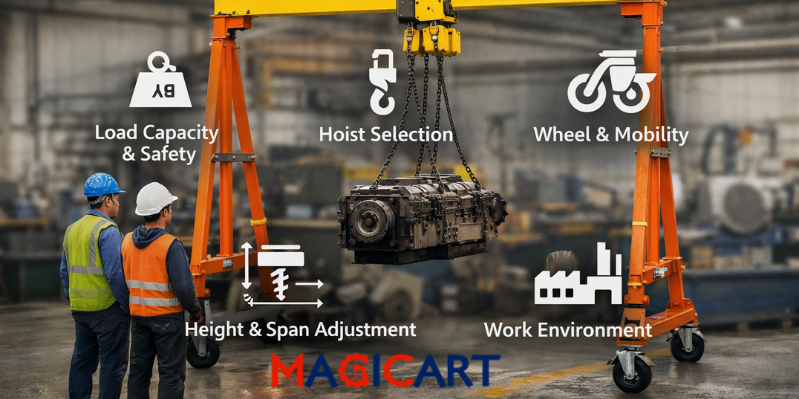
To choose the right mobile gantry crane for heavy lifting, confirm your maximum load and select the correct mobile gantry crane capacity with a safe operating margin. Measure lift height, span, and clearance, then determine whether an adjustable gantry crane is needed for variable loads or multiple work zones. Finally, match the hoist type and wheel configuration to your floor conditions and intended portable gantry crane applications to ensure safe and efficient operation.
Ready for a custom solution?
If you want a crane designed around your site, load profile, and workflow, Magicartcranes can help you select the ideal capacity, configuration, and features.
CTA: Request Custom Design / Get a Quote Share your load weight, lift height, span, and operating environment—our team will propose a safe, efficient solution built for your needs.
FAQ:
Q1. What capacity should I choose for a mobile gantry crane?
Ans.Choose a mobile gantry crane capacity that covers your heaviest lift with a safety margin. If your maximum load is close to the rated limit, stepping up to the next capacity class is often the safer choice—especially for frequent or long lifts.
Q2. When should I choose an adjustable gantry crane?
Ans.An adjustable gantry crane is ideal if you lift equipment of varying sizes, need different clearances, or want one crane to serve multiple areas. It’s also a smart option if future expansion is likely.
Q3. What are the most common portable gantry crane applications?
Ans.Typical portable gantry crane applications include maintenance workshops, fabrication shops, warehouses, and marine facilities where loads must be moved safely without fixed overhead cranes.
Q4. Can a mobile gantry crane be used outdoors?
Ans.Yes, but outdoor use depends on wheel selection, surface conditions, corrosion protection, and wind safety practices. If outdoor operation is planned, inform Magicartcranes so the design matches your environment.
Q5. How do I know which hoist is best?
Ans.Wire rope hoists are often better for heavy loads and frequent use due to smoother operation and durability. Chain hoists can be more economical for lighter, intermittent lifting. The best choice depends on duty cycle and lift requirements.